

BRIW BLOG

Location information and location terms — they're not the same, and everyone mixes them up.

When a decision is made to build a house, a commercial space, or any other facility, it's natural to want everything to start as soon as possible. However, before even obtaining a building permit, the procedure dictates that you go through a specific and extremely important phase called the conceptual design.

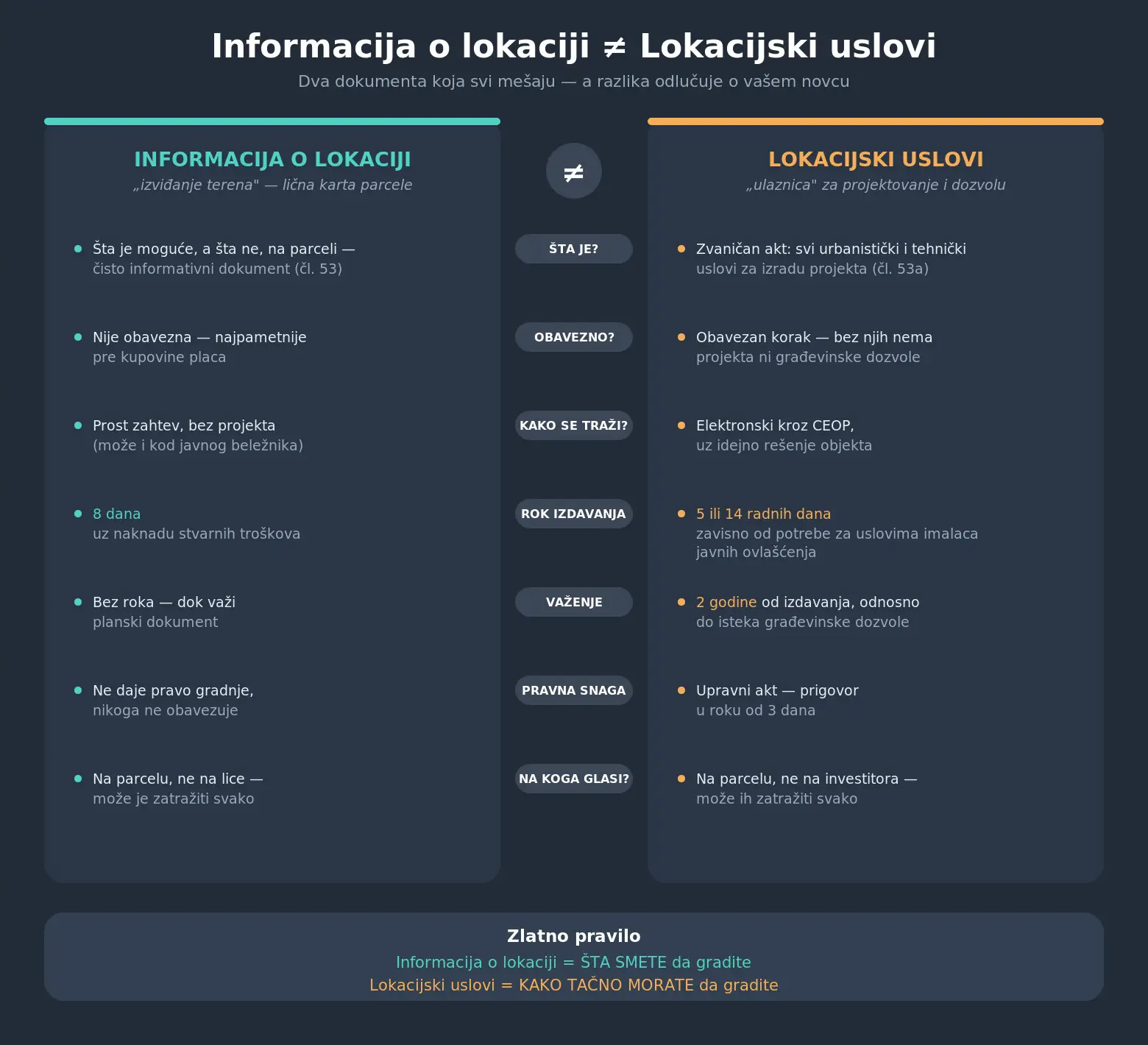
Information about the location and location conditions are not the same, and everyone confuses them
Contents
    Add a header to begin generating the table of contents

    Location Information – Parcel "ID Card"

    Location information (Article 53 of the Law on Planning and Construction) is a document that tells you what is possible and what is not on a plot, based on the valid planning document: land use, permitted number of floors, building footprint percentage, restrictions (protection zones, landslides, undeveloped roads...).

    Purely informational. It does not grant building rights, it does not obligate anyone, and based on it, nothing can be designed or built.

    It is not mandatory. You look for it when you want – the smartest thing before buying a plot, to tell you if you can build the desired object at all, or not to pay for farmland at the price of building land.

    Fast and easy. It is issued within 8 days, at the expense of actual costs. The request is simple, without a project, without technical documentation. According to the new amendments to the law, it can also be issued by a public notary or a registered urban planning company.

    Think of it like scouting the terrain: cheap, fast, and can save you from expensive mistakes.

    Site conditions – a ticket to design

    Location conditions (Article 53a) are an official document containing all urban planning and technical conditions for project development: building regulations for your plot, conditions for connection to electricity, water, sewage, and roads, information about structures to be removed, and any obligation for environmental impact assessment.

    Mandatory step for a building permit - without them there is no conceptual design, construction permit design, or execution design.

    Search through CEOP, electronic, and not with an „empty“ request: a conceptual design of the future building is attached. So, you already need a designer.

    The organization works for you. The conditions for public utility companies (electricity distribution, water supply, etc.) are obtained by the competent authority ex officio; they are obliged to respond within 15 days, and the authority issues the conditions within 5 working days of completion.

    They have legal force. You can file an objection to the issued conditions within 3 days. Once the building permit becomes legally binding, the location conditions can no longer be challenged; they can only be changed if the building permit itself is changed.

    Valid for 2 years from issuance, or until the expiration of the building permit issued on their basis.

    The difference in one sentence

    Location information tells you if and what you can build. Location conditions tell you exactly how you must do it – and without them, construction doesn't start.

    Typical order of practice

    Before buying a plot → location information (whether the plot is suitable for the desired object at all)

    Decision on construction designer creates a conceptual design

    Request through CEOP location conditions

    Next is the project for the building permit, permit, work application... but that's another story.

    A common and expensive mistake: skip step 1, buy a plot „on a gut feeling“, only to find out from the location conditions that a planned road is going through the plot or that the permissible number of floors is Ground Floor + 1 instead of the dreamed-of five floors.

    Therefore, the key to successful construction is timely information. Understanding the purpose of these two documents lays a stable foundation for the entire project, saves time and money, and ensures that your investment is legally and technically secure from the very beginning.

    More interesting topics

    What is a conceptual design and why is it the first, indispensable step in construction? Architecture

    What is a conceptual design and why is it the first, unavoidable step in construction?

    When a decision is made to build a house, commercial space, or any other facility, it's natural to want everything to start as soon as possible. However, before...
    5 Mistakes Investors Make When Renovating an Apartment (and How to Avoid Them in Time) Interior

    5 Mistakes Investors Make When Renovating an Apartment (and How to Avoid Them in Time)

    Buying an apartment is only half the job. The real challenge begins when you step into an empty space with keys in your hands and big dreams of a perfect home. Whether...

    How does the CEOP system work? Architecture

    How does the CEOP system work?

    Learn what CEOP is and how it has completely digitized the construction permit issuance process in Serbia – paper counters are a thing of the past. In this detailed guide, we reveal...