


BRIW BLOG

How does the CEOP system work?

Learn what CEOP is and how it has completely digitized the building permit issuance process in Serbia – paper counters are a thing of the past. In this detailed guide, we reveal how the system works, what its real advantages are, and what is needed to successfully navigate the procedure.

How does the CEOP system work?
Contents
    Add a header to begin generating the table of contents

    How does CEOP work

    If you are planning to build a family home, renovate an apartment, add to a commercial space, or legalize existing square footage, you will sooner or later encounter the abbreviation CEOP.

    For many who are new to the world of construction regulations, administrative procedures sound like a nightmare full of endless queues and chasing „one piece of paper.“ However, in Serbia, this area has undergone a major digital transformation. Thanks to the CEOP system, paper-based counters for building permits are a thing of the past, and the entire process has moved to a digital format.

    In this detailed guide, you will learn exactly what CEOP is, how it works in practice, what its real advantages are, and what is needed for successful completion of the procedure.

    What is CEOP?

    CEOP is an abbreviation for the Central Electronic Record of Consolidated Procedures. It is a unique, centralized electronic system of the Republic of Serbia through which all requests are submitted and all acts related to the construction, reconstruction, and equipping of facilities are issued.

    The system is technically managed by the Serbian Business Registers Agency (APR). As of January 1, 2016, the implementation of this system has become a mandatory legal obligation. This means that competent authorities no longer accept requests in paper form – everything is done exclusively digitally.

    "Unified Procedures" Principle: One Counter Instead of Ten

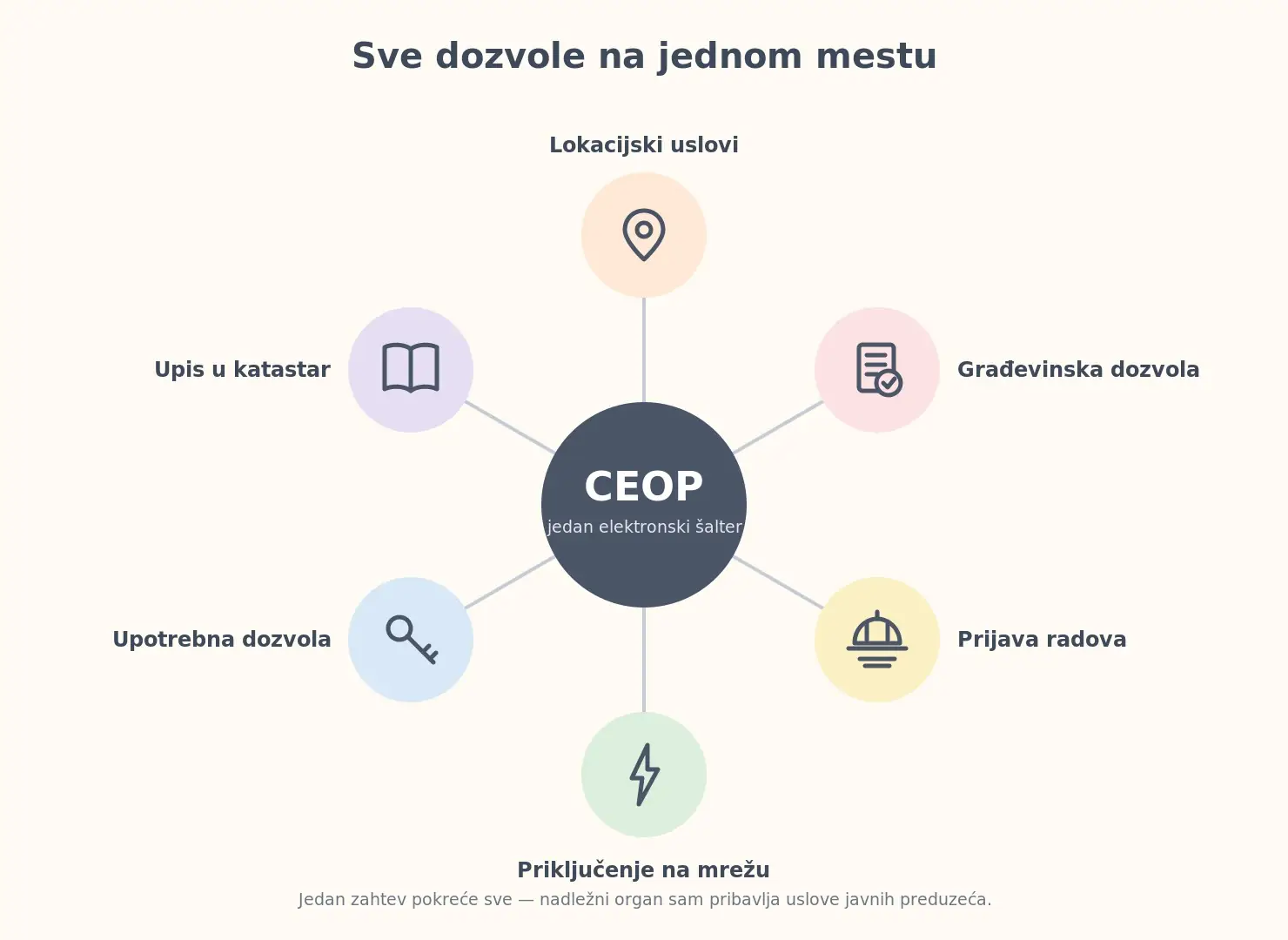
    The greatest value of CEOP lies in the introduction of the so-called unified procedure. Before the introduction of this system, investors had to go door to door on their own – from the cadastre, through the electricity distribution and water supply, all the way to telecommunications and other institutions – in order to collect a pile of conditions and approvals.

    Today, this work is done through the system by the competent authority. The system functions on the principle of a single electronic counter. An application is submitted, and the competent authority is obligated, ex officio, through the system, to obtain all necessary technical conditions and approvals from all public enterprises and institutions (so-called public authorities).

    What does the CEOP procedure look like in practice? (Step by step)

    The CEOP process occurs in several clear phases, but it requires careful and manual data management:

    1. Electronic Application Submission
    The request is created and completed on the official portal ceop.apr.gov.rs. To successfully submit the request, the person submitting it must possess a qualified electronic signature (e-signature). The request can be submitted by the investor personally, but in reality, it is most often submitted by an authorized representative (e.g., a licensed design bureau) on their behalf.

    2. Selection of the Competent Authority and Submission
    Unlike fully automated systems, in CEOP, the applicant must manually enter and select the institution (a specific municipal administration, city urban planning secretariat, or relevant ministry) to which they are submitting the application, depending on the location and type of facility.

    3. Institutional Communication and Procurement of Conditions
    When the competent authority receives a request, it sends inquiries through the system to public utility providers (EPS, Waterworks, Telekom, etc.). These companies have strict deadlines to submit their design and connection requirements directly through the system.

    4. Decision Making and Notifications
    After checking for formal correctness, paying the administrative fee, and submitting the necessary documentation, the competent authority makes a decision. Legal deadlines for making a decision vary depending on the type of request itself. Once the decision is made, the final, digitally signed resolution is sent to the authorized representative through the CEOP system. The system automatically sends a notification to all participants in the procedure whose email addresses are listed and registered in the system.

    What is achieved and resolved through CEOP?

    The complete lifecycle of constructing a facility is managed through a unified procedure:

    Location Conditions — The first step in which urban and technical conditions for design and connection to infrastructure are defined.

    Building permit — Official approval to begin construction of a building.

    Solution pursuant to Article 145. — Necessary for adaptations, reconstructions, changes of use, or construction of minor auxiliary structures.

    Work notification — Notice of the exact start date of field work.

    Application for completion of foundations and completion of the building - Control phases of the construction process.

    Connection to infrastructure - Request to public utility companies for physical connection to networks (electricity, water, gas...).

    Occupancy permit — Confirmation that a building was constructed in accordance with the building permit and is safe for use.

    Object registration in the cadastre — Forwarding of documents for registration of ownership rights.

    Key advantages of the CEOP system

    Monitoring the procedure within the system — The person conducting the procedure has full control and can monitor the status of the case through the portal at any time, see where the request is located, and which documents have arrived. The flow of the case is not public to third parties — only persons conducting the procedure have access through their account.

    Stricter institutional deadlines — All actors within the system (municipalities, public enterprises) are bound by deadlines for action, which significantly speeds up the process compared to the former paper-based work.

    Ecological and financial aspect — No need to print extensive projects, physically deliver documentation, or purchase paper stamps. Everything is submitted, archived, and paid for electronically.

    Although CEOP has accelerated communication between institutions, the quality and accuracy of technical documentation continue to play a crucial role. Any formal inconsistency or incorrectly entered data leads to the rejection of the request, which is why a detailed understanding of the system's operating rules is of paramount importance for the successful realization of any construction project.

    More interesting topics

    Information about the location and location conditions are not the same, and everyone confuses them Procedure

    Information about the location and location conditions are not the same, and everyone confuses them

    When a decision is made to build a house, commercial space, or any other facility, it's natural to want everything to start as soon as possible. However, before...
    What is a conceptual design and why is it the first, indispensable step in construction? Architecture

    What is a conceptual design and why is it the first, unavoidable step in construction?

    When a decision is made to build a house, commercial space, or any other facility, it's natural to want everything to start as soon as possible. However, before...

    5 Mistakes Investors Make When Renovating an Apartment (and How to Avoid Them in Time) Interior

    5 Mistakes Investors Make When Renovating an Apartment (and How to Avoid Them in Time)

    Buying an apartment is only half the job. The real challenge begins when you step into an empty space with keys in your hands and big dreams of a perfect home. Whether...